
Insight No.19 |
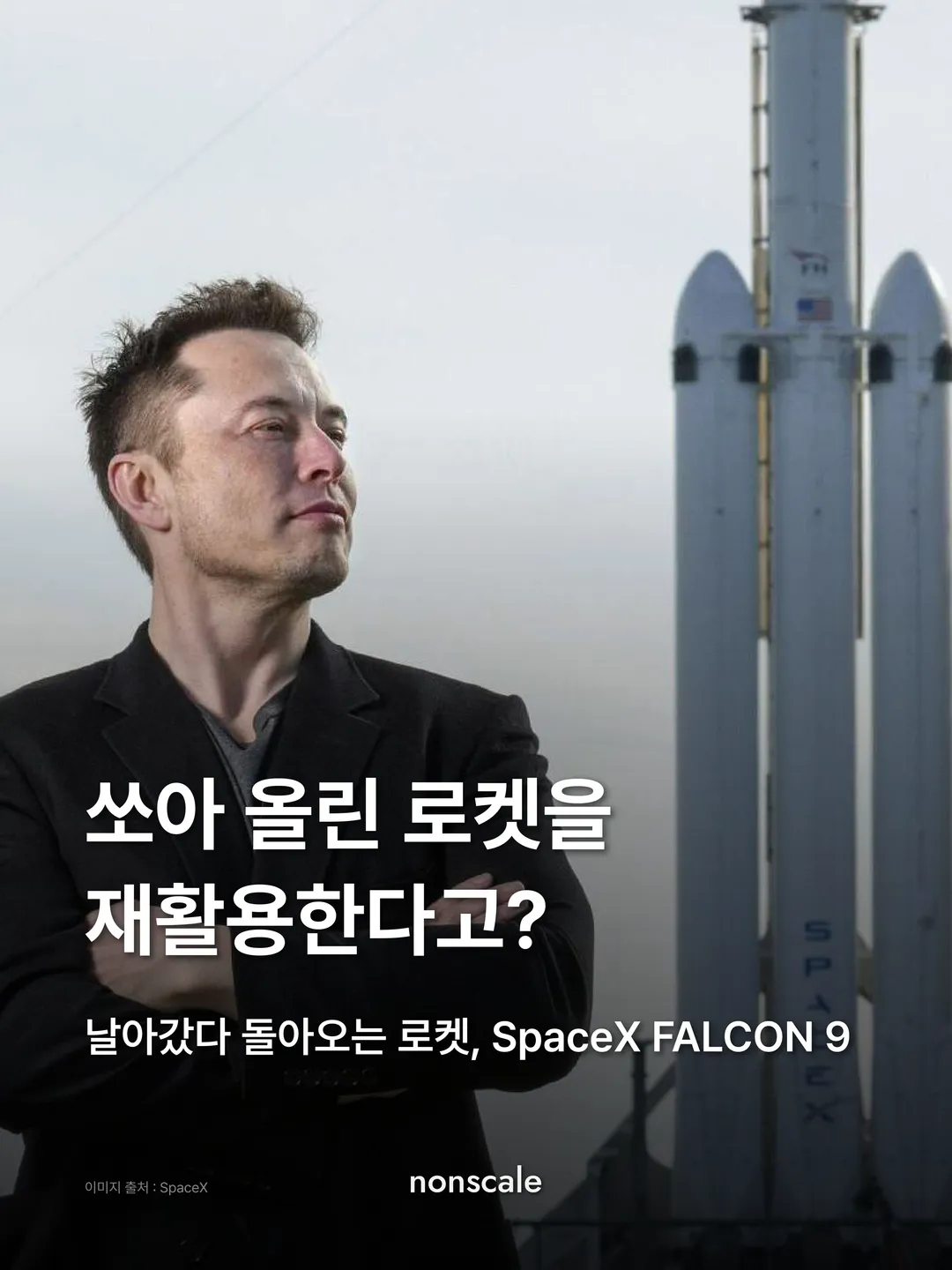
Reusing a rocket after launch?
The rocket that flies off and comes back, SpaceX FALCON 9
To reach Mars, rockets had to be cheap.By reusing the rocket's most expensive part,SpaceX cut costs and flew more often.Finding why it was expensive was the breakthrough.
One SpaceX launch costs 80 billion won, and only 400 million won of that is fuel 🚀SpaceX (@spacex)
Elon Musk founded SpaceX in 2002 because of Mars. Building a city where people could live on Mars would take countless launches. But a single launch cost about 80 billion won. At that price, even launching often was hard, let alone reaching Mars.
Of the 80 billion won, fuel was only about 400 million won. The rest was the rocket itself, and after one launch it fell into the sea. If an airplane were thrown away after one flight, a single ticket would cost as much as the plane. Rockets were expensive because they were used only once. So the company decided to reuse rockets the way airplanes are reused.
The company's rocket, Falcon 9, has two stages. The first stage at the bottom pushes the rocket up and separates in under three minutes, and the second stage on top then carries the payload to space. The name Falcon came from a spaceship in a film, and the 9 from the nine engines on the first stage. That first stage, with its nine engines, makes up more than half the rocket's cost. The part to recover was the first stage.
From its first launch in 2010, Falcon 9 carried payloads to space without trouble. The hard part was coming back. To return, the first stage had to save fuel for the descent, and the weight of that fuel cut the payload it could carry. Landing practice began in 2013, but the stage broke up time after time. In January 2015 it crashed while landing, and in April it landed and then tipped over. In June a rocket broke apart on the way up, and launches stopped for six months.
On the night of December 21, 2015, on the first rocket to fly again, the first stage that had sent its payload up stood itself upright. On the way down it relit its engines to slow its fall, and just before touching the ground it unfolded four legs and stood up straight. The founder, watching outside, heard only the roar at touchdown and thought it had exploded. He said he went back inside and saw the first stage standing on the screen.
In March 2017, a recovered first stage flew again carrying a communications satellite. The first stage was used as it was; only the second stage and the fairing were new. Refurbishing a recovered first stage cost far less than building a new one. The founder calculated that a stage would break even on its second flight and turn a profit from the third.
Falcon 9, which flew twice in 2010, flew 165 times in 2025. That was one in every two orbital rockets launched from Earth that year. The same year, the same first stage was launched again just nine days later. Without building the first stage, more than half the cost, new every time, the company could launch without waiting for a new rocket. In August 2026, a single first stage flew for the 37th time.
Worth adding: the company's costs went down, but the price it charged customers did not. The savings went into more launches. Of the 165 launches in 2025, 123 carried the company's own internet satellites.
To reach Mars, rockets had to be cheap.
By reusing the rocket's most expensive part, SpaceX cut costs and flew more often.
Finding why it was expensive was the breakthrough.
essence
To reach Mars, rockets had to be cheap.By reusing the rocket's most expensive part,SpaceX cut costs and flew more often.Finding why it was expensive was the breakthrough.
what's your nonscale?
A rocket that cost 80 billion won used only 400 million won of fuel. What around you is expensive because it is used once and thrown away? 🚀
#elonmusk #elonmuskquotes #elonmusknews #nasa #space #spacex #falcon #falcon9 #rocket · Where it happened: Cape Canaveral,Florida
8 references · photo credits
- SpaceX, “Reusability: The Key to Making Human Life Multi-Planetary” (spacex.com)
- SpaceX, Falcon 9 · Launches (spacex.com)
- CNBC, “Full Elon Musk transcript about SpaceX Falcon 9 Block 5” (2018)
- Inverse, “SpaceX: Elon Musk breaks down the cost of reusable rockets” (2020)
- Space.com, “SpaceX Lands Orbital Rocket Successfully in Historic First” (2015)
- Space.com, “SpaceX shatters its rocket launch record yet again — 165 orbital flights in 2025” (2026)
- SpaceNews, “SpaceX, China drive new record for orbital launches in 2025” (2026)
- Wikipedia, “Falcon 9” · “Falcon 9 first-stage landing tests” · “Autonomous spaceport drone ship”
Photo credits · 01·02·03·05·10 SpaceX · 04 Redbubble · 06 The Seattle Times · 07 Wikipedia · 08 design.co.kr · 09 heypop.kr · 11 Fox Business