
Insight No.13 |
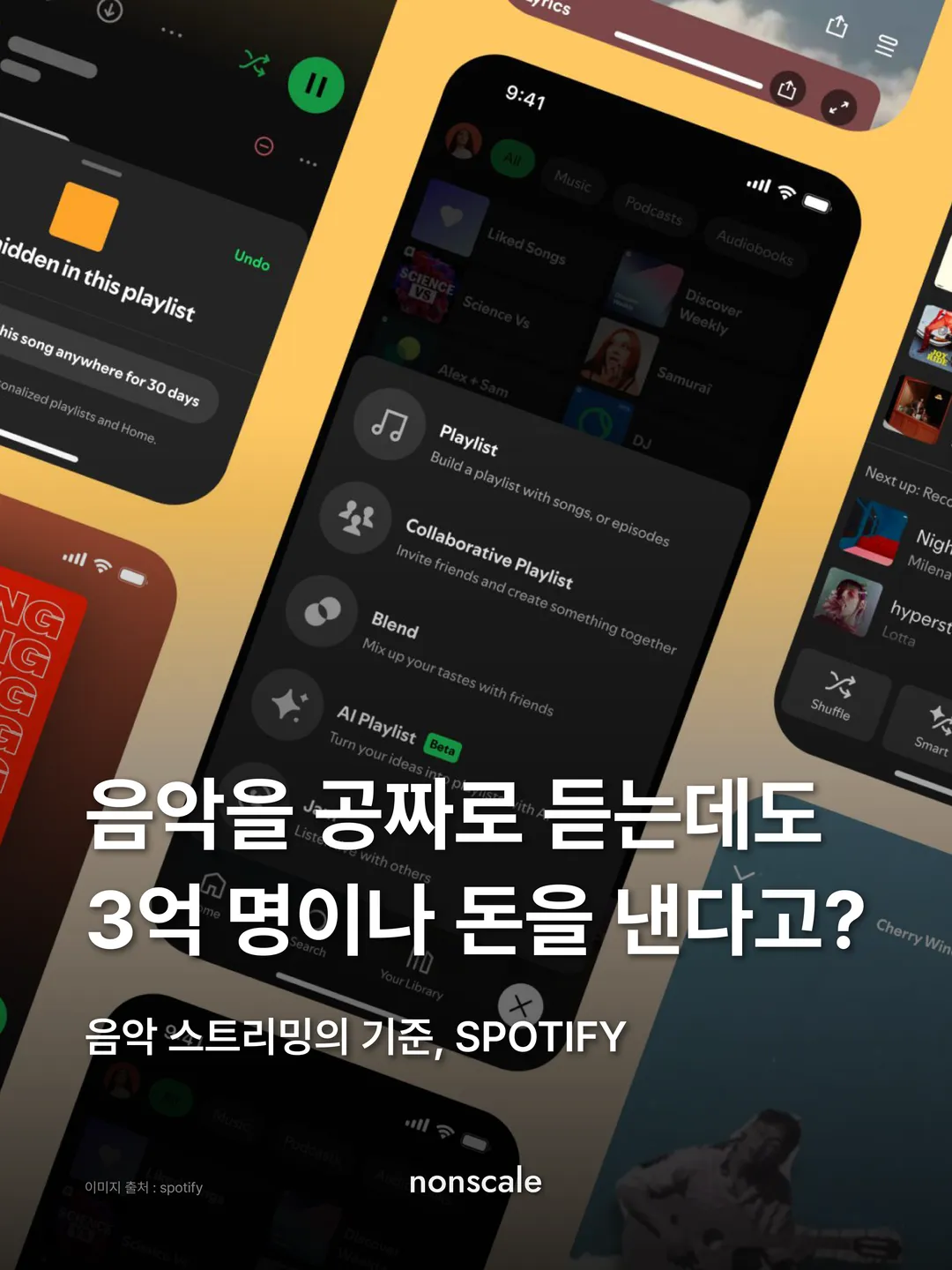
Music is free to stream, yet 300 million people pay?
The standard for music streaming, SPOTIFY
Why is there no button to buy a song on Spotify? 🎧Spotify (@spotify)
For a long time, music was priced as an object. In the early 2000s, a CD went for as much as 18 dollars, and the one song you wanted was somewhere inside it. From 2003 you could pick a single song and buy it for 99 cents, but the premise stayed the same. If you didn't buy it, you couldn't listen.
In April 2006, a 23-year-old and his business partner founded a company in Stockholm. In May that year, a file-sharing site in the same city was raided by police. It was a time when neither lawsuits nor copy protection could stop it. The company's name came from a word misheard when the two were calling out between rooms. A search turned up no results, so they bought the domain that day.
The goal the two set was better than piracy: build something better than illegal copying. The goal the founder described later was more specific: all the world's music on your hard drive, making it feel as if every song in the world were already on your computer. At a time when downloading one file took minutes, speed was the key. The company bought an entire company that had built a file-sharing program. In measurements in a paper published later, the median time from pressing play to hearing sound was 0.265 seconds.
In October 2008, it opened with free listening supported by ads. There was no time limit and no limit on songs. Paying removed the ads, at 9.99 dollars a month. The price of a 12-song album became the price of a month, and in the US that price did not rise from 2011 to 2022. Persuading the record labels took time, and the company gave them equity along with the licenses. The major labels and an independent alliance are reported to have received 18 percent.
In 2011, it also tried a download store for buying and keeping songs one at a time. In early 2013, it closed that store. Few people used it, reportedly. People chose listening over owning.
In 2014, it acquired a company that built music recommendation technology. Since July 2015, every Monday it sends 30 songs picked by an algorithm from your listening history. Since 2016, at the end of each year, it gives back your listening history for the year. Where record labels once bundled twelve songs, your own listening history now sits.
Payouts are made by listening history too. The company sets no fixed rate per play. It pools subscription fees and ad revenue and divides them by share of that month's total plays. The company calls this streamshare. About two thirds of music revenue goes to rights holders; in 2025 alone, more than 11 billion dollars was paid out that way.
In 2024, 18 years after its founding, it posted its first annual profit. 300 million people pay to listen; counting those who listen free, it is 770 million. Recorded music revenue fell for 15 years from its 1999 peak to 2014, and has now been rising for 11 years. In that time, LP sales have also grown for 19 years in a row.
Worth adding: paying a monthly fee to listen actually started first in Korea, in 2004. What this company did differently was make free the entrance, put no price on a single song, and leave choosing to listening history. The debate over how much one play should earn continues today. Once the way of dividing is set, the price follows it.
It offered unlimited music. Creators earn from listening time.
For consumers, listening time becomes taste. Only the way of selling changed.
essence
It offered unlimited music.Creators earn from listening time.For consumers, listening time becomes taste.Only the way of selling changed.
what's your nonscale?
Every Monday, Spotify sends 30 songs picked from your listening history. Did you like this Monday's list? 🎧
#스포티파이 #Spotify #음악스트리밍 #플레이리스트 · Where it happened: Stockholm, Sweden
9 references · photo credits
- Spotify Newsroom, “Fourth Quarter 2024 Earnings” · “Second Quarter 2026 Earnings”
- Spotify, “Understanding Spotify royalties” (support.spotify.com) · “Loud & Clear 2026”
- G. Kreitz, F. Niemelä, “Spotify — Large Scale, Low Latency, P2P Music-on-Demand Streaming”, IEEE P2P (2010)
- IFPI, “Global Music Report 2026” (ifpi.org)
- ABC News, “Spotify Founder Wanted to Create Something Better than Piracy” (2012)
- Daniel Ek, Quora 답변 “What were the early decisions key to Spotify’s success?” (2016)
- Digital Trends, “Spotify’s music download option indefinitely shelved worldwide” (2013)
- Music Business Worldwide, “How many shares the major labels bought in Spotify” (2018)
- Spotify Newsroom, “Spotify Acquires The Echo Nest” (2014) · “Introducing Discover Weekly: Your Ultimate Personalised Playlist” (2015)
Photo credits · 01·04·05·07·08·09·10·11 spotify · 02 walmart · 03 themagicroast.substack.com · 06 spotifynewsroom